Heart & Lipids
Lp(a) test cost: $24–$55
By Elo. Last updated October 19, 2026.
An Lp(a) test costs $24 at Precision Health Reports, with no separate draw or physician-order fee. The lowest-priced panel we compare that includes Lp(a) is Empirical Health's Comprehensive Health Panel at $190 one-time.
Lp(a) is a cardiovascular risk factor a standard cholesterol panel does not measure. Your level is set almost entirely by the genes you were born with, so unlike LDL it barely moves with diet, exercise, or a statin.
About one in five people carry an elevated Lp(a), and most have no idea. The 2026 ACC/AHA cholesterol guideline now says to measure it at least once in every adult, and Aetna updated its policy to cover exactly that, a one-time test for anyone 19 or older. That makes Lp(a) the rare screening test worth running through insurance before you reach for a cash price.
Below, we compare what an Lp(a) test costs at every lab that sells it, what you'd pay inside a bundle, and how the coverage question plays out. If you're ordering a broader heart workup, the ApoB + Lp(a) + lipid panel comparison prices the complete combination.
How much does an Lp(a) test cost?
An Lp(a) test costs $24 at Precision Health Reports, with no separate draw or physician-order fee. The lowest-priced panel we compare that includes Lp(a) is Empirical Health's Comprehensive Health Panel at $190 one-time. These are cash prices for ordering without insurance.
Which providers sell Lp(a) tests, and what do they charge?
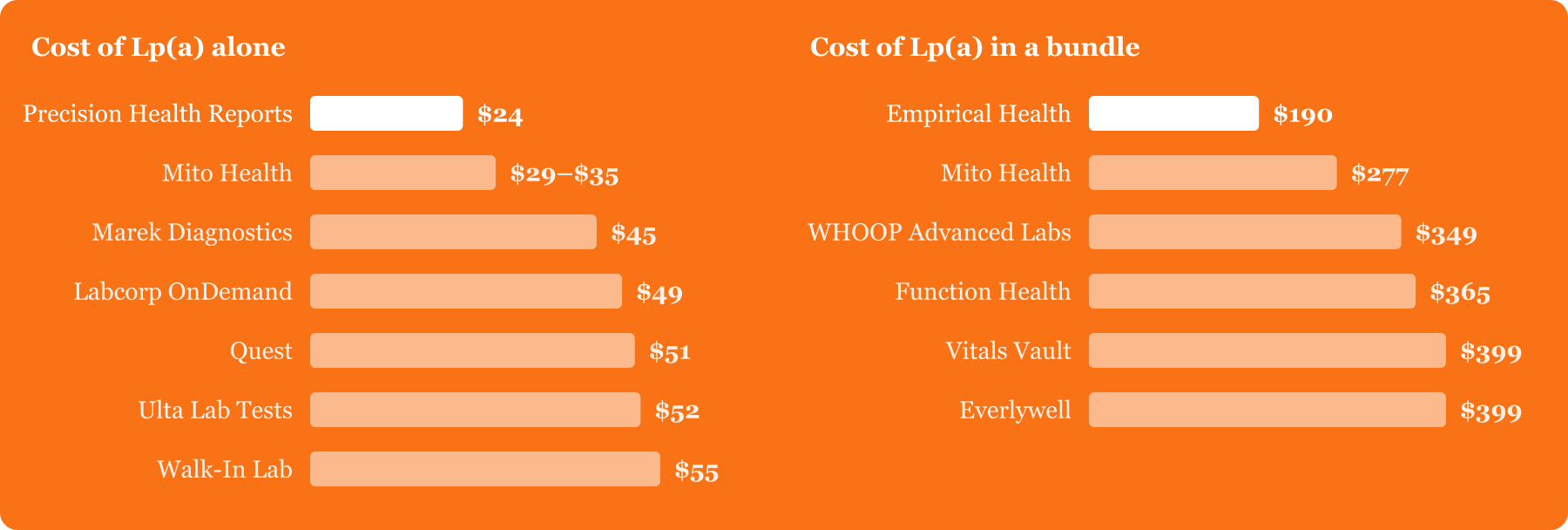
The lowest cash price we found for Lp(a) is $24 at Precision Health Reports, followed by Mito Health ($29–$35), JustLabs ($39), Own Your Labs ($41), Marek Diagnostics ($45), Labcorp OnDemand ($49), Quest ($51), Ulta Lab Tests ($52), and Walk-In Lab ($55). These are all-in prices that include the draw fee: Mito Health lists Lp(a) at $19.66 and adds a $9.50–$15 draw fee, for $29.16–$34.66 total.
A Lp(a) test costs $39 at JustLabs: $21 + $18 lab & physician order fee = $39. Verified October 18, 2026. Quest draw. One $18 fee per order includes the blood draw and physician order.
A Lp(a) test costs $41.20 at Own Your Labs: $35.20 + $6 draw fee = $41.20. Verified October 18, 2026. Labcorp draw. Unavailable to residents of Massachusetts, Maryland, New Jersey, New York, or Rhode Island. Regular price; optional 10% data-sharing discount excluded.
What is the cheapest panel that includes Lp(a)?
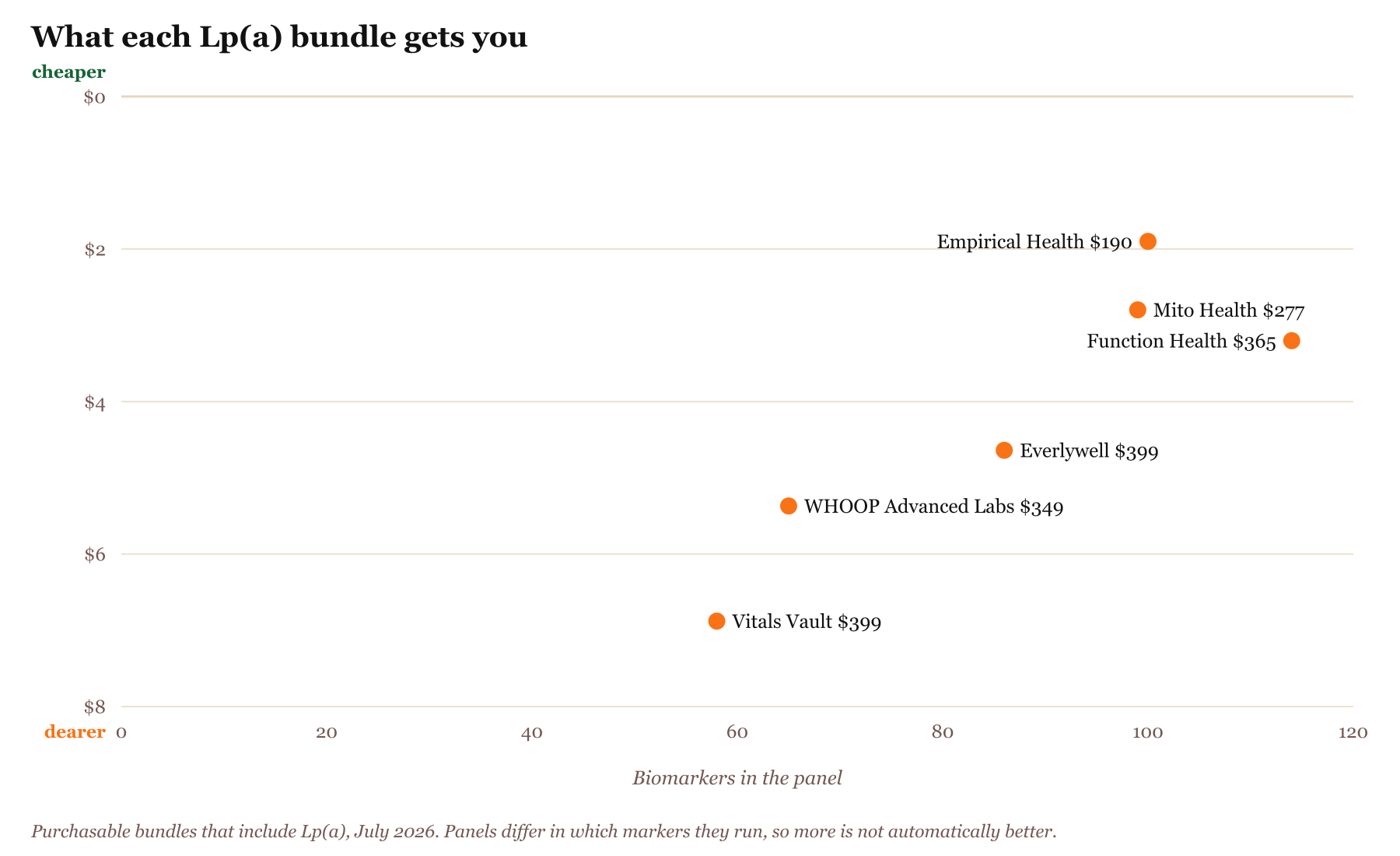
Six packages we track include Lp(a), and every one of them tests dozens of other markers from the same draw. The cheapest bundle with Lp(a) is Empirical Health's 100-biomarker panel at $190, then Mito Health ($297 for 99 markers), WHOOP Advanced Labs ($349 for 65 markers), Function Health ($365 for 119 markers), Vitals Vault ($399 for 58 markers), and Everlywell ($399 for 86 markers). Goodlabs includes Lp(a) in a 14-biomarker panel that's free with a blood donation.
How much does an Lp(a) test cost at Quest Diagnostics?
At Quest Diagnostics, a Lp(a) test costs $51 on its own.
Is an Lp(a) test worth it?
Yes, once. Lp(a) is set by your genes and barely moves over your lifetime, so a single test either finds an inherited risk that standard cholesterol panels miss or rules it out for good. About 1 in 5 people carry an elevated level and most of them have no idea. The 2026 ACC/AHA guideline now says every adult should have it measured at least once, and Aetna covers exactly that. Buying it a second time is a waste unless you start a therapy aimed at lowering it.
Either way, the price shouldn't be what decides it: Precision Health Reports sells Lp(a) for $24 all-in. The cheapest panel that includes it is Empirical Health at $190, which is only worth it if you want the other 99 markers too.
Does insurance cover an Lp(a) test?
Coverage for Lp(a) is split, and it's moving. Some major payers now cover a one-time test for every adult, while others still treat it as screening and deny it without symptoms. Covered in-network, you pay about $15 to $30. A denied claim can run $75 to $400, against $24 to pay cash. Ask your plan before you order it, because this is one of the few tests where the answer changed recently.
Aetna covers a “one-time lipoprotein(a) [Lp(a)] test for all adults aged 19 years and older,” with repeat testing considered not medically necessary. That language is new, added in the bulletin's June 2026 review, months after the March 2026 ACC/AHA guideline told clinicians to measure Lp(a) once in every adult. This is the rare screening test a major insurer now covers for everyone, so run it through insurance first, but ask your own plan, since payers are rewriting these policies at different speeds.
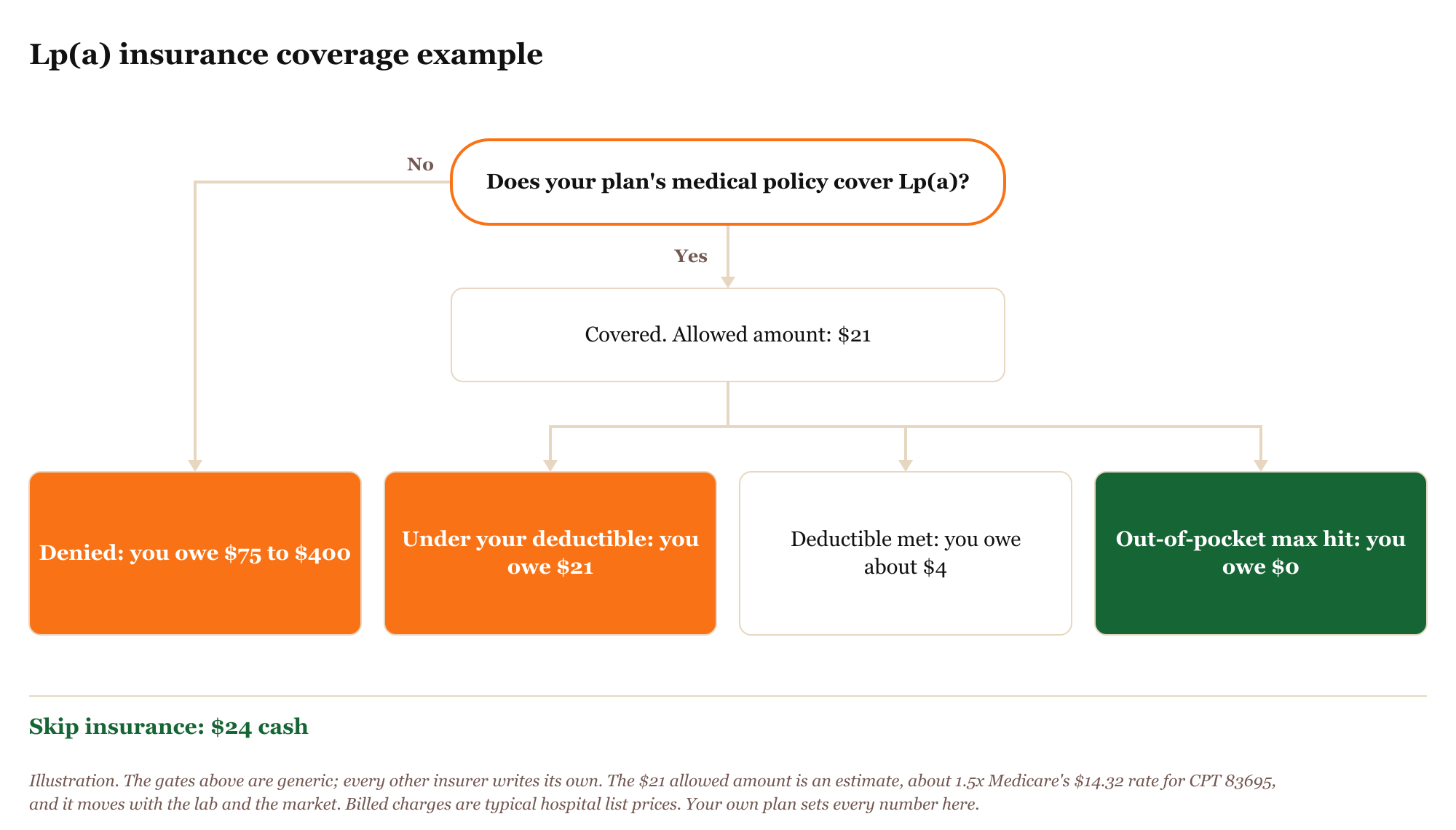
The $21 allowed amount is an estimate, about 1.5x Medicare's $14.32 rate for CPT 83695, and it moves with the lab and the market: the same test is contracted around $18 at one national lab and into the $40s at another. Coinsurance is assumed at 20% once your deductible is met. Your own plan decides both, and most plans apply lab work to the deductible first, so the second outcome above is the one most people land on.
Lp(a) is billed as CPT 83695. That's the code to quote if you call your insurer to ask what you'd owe.
Do medical guidelines recommend an Lp(a) test?
Lp(a) has moved from a niche test into mainstream, guideline-backed screening.
- Cardiology guidelines. In March 2026, the American College of Cardiology and American Heart Association released a new dyslipidemia guideline recommending that every adult have their Lp(a) measured at least once in adulthood. Because Lp(a) is largely inherited and stays stable over your lifetime, a single measurement is usually enough.
- Lp(a) researchers. Leading researchers describe Lp(a) as one of the most important inherited, causal risk factors for heart disease. Dr. Sam Tsimikas of UC San Diego has told tctMD, “You can explain about one-third of coronary artery disease with elevated Lp(a) and you can explain about 37% of aortic valve disease.”
Frequently asked questions about Lp(a) testing
What is the cheapest way to get an Lp(a) test?
An Lp(a) test costs $24 at Precision Health Reports, with no separate draw or physician-order fee. The lowest-priced panel we compare that includes Lp(a) is Empirical Health's Comprehensive Health Panel at $190 one-time.
Do I need a doctor's order to get an Lp(a) test?
No. The standalone Lp(a) tests listed above include the physician order in their price, so you can buy online and have your blood drawn without seeing a doctor first. You'd only need your own doctor's order if you want to bill the test to insurance.
How much does an Lp(a) test cost at LabCorp?
LabCorp doesn't publish a flat consumer price for Lp(a), and what you're charged varies by location. The cheapest way to have Lp(a) drawn at a LabCorp Patient Service Center is through Precision Health Reports, a LabCorp-network lab, at $24 all-in.
How much do Lp(a) and ApoB tests cost together?
Because one blood draw covers both, the cheapest way to get Lp(a) and ApoB together is Mito Health, at $41 for the pair. Empirical Health's 100-biomarker panel ($190) is the cheapest bundle that includes both.
How often do I need an Lp(a) test?
Usually just once. Lp(a) is set largely by your genes and stays stable through life, so a single measurement tells you whether you carry an elevated, inherited risk. Retesting mainly matters if you start a therapy aimed at lowering Lp(a).
What counts as a high Lp(a) level?
Risk generally rises above about 50 mg/dL (or 125 nmol/L), and roughly 1 in 5 people worldwide carry elevated levels. A standard cholesterol panel does not detect Lp(a), which is why it needs its own test.