Thyroid
TSH test cost: $14–$55
By Elo. Last updated October 18, 2026.
A TSH test costs $14, and it's the right first test for a thyroid question, but only if you have a question. The US Preventive Services Task Force found the evidence “insufficient to assess the balance of benefits and harms of screening for thyroid dysfunction in nonpregnant, asymptomatic adults.”
With symptoms, it's a different test entirely. Unexplained fatigue, weight change, cold intolerance, hair loss, or irregular periods are what TSH is for, and it's sensitive enough to pick up thyroid trouble before free T4 moves. Insurance generally covers it when a doctor orders it for symptoms, which is why the cash price matters most to people buying it on their own.
Below, we compare what a TSH test costs at each lab, inside a bundle, and what insurance pays.
How much does a TSH test cost?
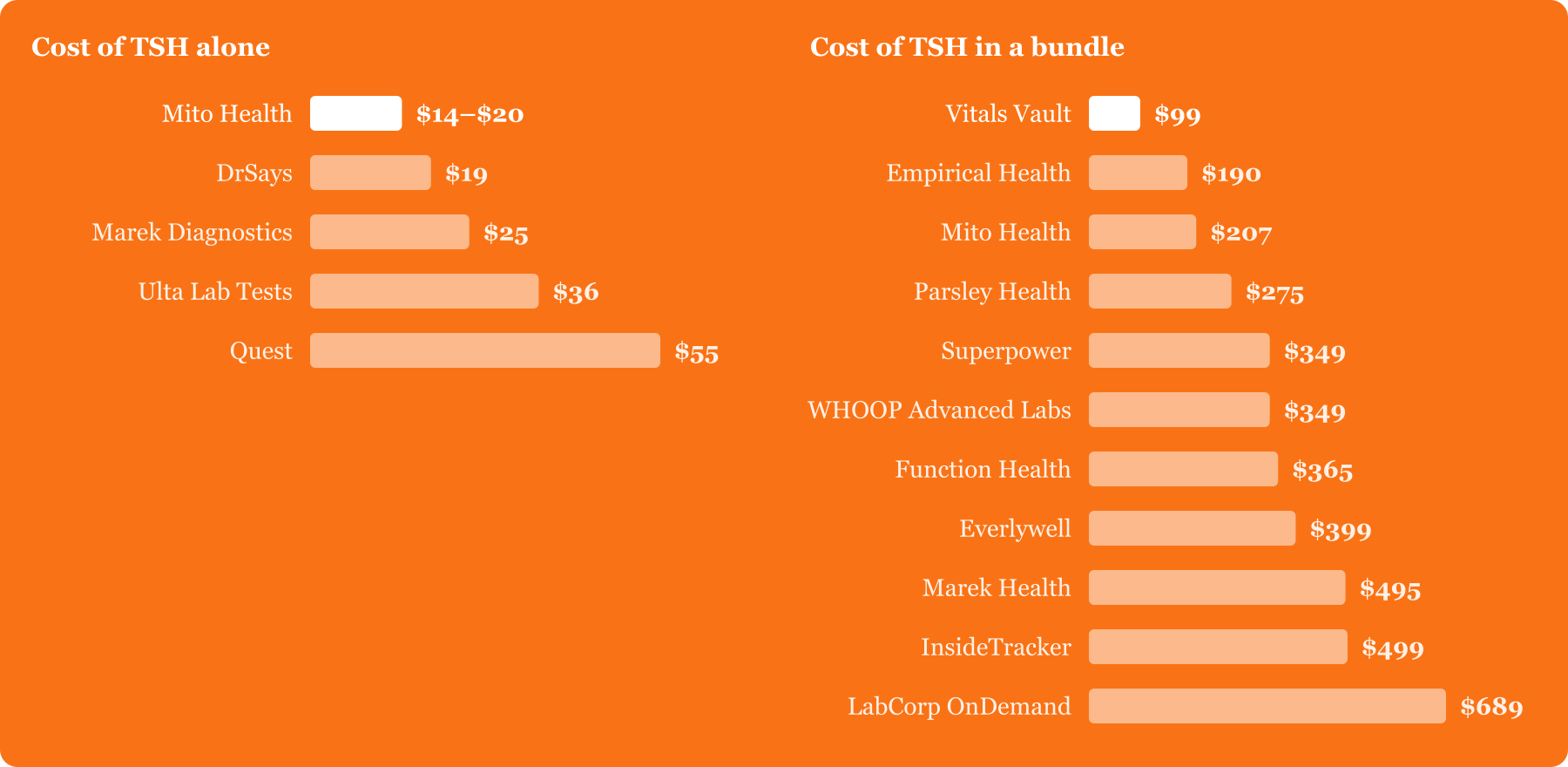
TSH costs $14–$55 on its own, or $99–$689 in a bundle. Those are cash prices, so that's also what TSH costs without insurance.
Lowest TSH self-pay prices
The lowest cash price we found for TSH is $14–$20 at Mito Health, followed by DrSays ($19), Own Your Labs ($19), Marek Diagnostics ($25), JustLabs ($27), Ulta Lab Tests ($36), and Quest ($55). These are all-in prices that include the draw fee: Mito Health lists TSH at $4.92 and adds a $9.50–$15 draw fee, for $14.42–$19.92 total.
Own Your Labs: $13.20 + $6 draw fee = $19.20. Verified October 18, 2026. Labcorp draw. Unavailable to residents of MA, MD, NJ, NY, or RI. Regular price; optional 10% data-sharing discount excluded.
JustLabs: $9 + $18 lab & physician order fee = $27. Verified October 18, 2026. Quest draw. One $18 fee per order includes the blood draw and physician order.
Cost of TSH in a bundle
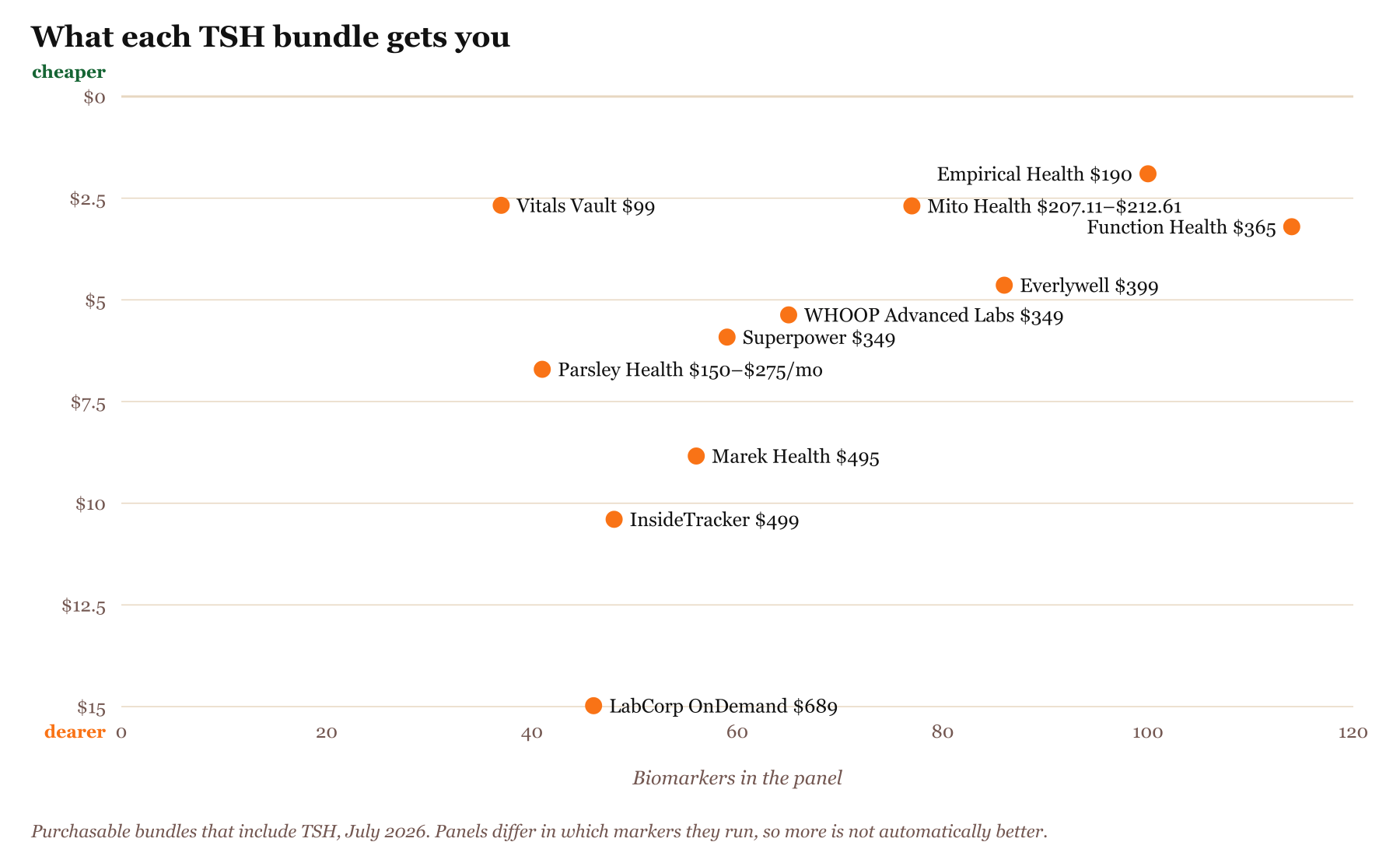
Eleven packages we track include TSH, and every one of them tests dozens of other markers from the same draw. The cheapest bundle with TSH is Vitals Vault's 37-biomarker panel at $99, then Empirical Health ($190 for 100 markers), Superpower ($199 for 59 markers), Mito Health ($207 for 77 markers), Parsley Health ($275 for 41 markers), WHOOP Advanced Labs ($349 for 65 markers), Function Health ($365 for 119 markers), Everlywell ($399 for 86 markers), InsideTracker ($489 for 46 markers), Marek Health ($495 for 56 markers), and LabCorp OnDemand ($689 for 46 markers). Goodlabs includes TSH in a 14-biomarker panel that's free with a blood donation.
How much does a TSH test cost at Quest Diagnostics?
At Quest Diagnostics, a TSH test costs $55 on its own.
Is a TSH test worth it?
Worth it if you have symptoms, not as a routine annual number. TSH is the right first test when you're dealing with unexplained fatigue, weight change, cold intolerance, hair loss, or irregular periods, and it's cheap. As a screen in people who feel fine it mostly turns up mildly abnormal results that resolve on a repeat draw and lead to more testing rather than better health.
Either way, the price shouldn't be what decides it: Mito Health sells TSH for $14 all-in. The cheapest panel that includes it is Vitals Vault at $99, which is only worth it if you want the other 36 markers too.
Does insurance cover a TSH test?
Insurance usually covers TSH when a doctor orders it for symptoms or a known condition, though you may still owe a copay or deductible. The in-network negotiated cost is about $15 to $35, against $14 if you pay cash. At a hospital lab the billed charge can reach $150 to $750.
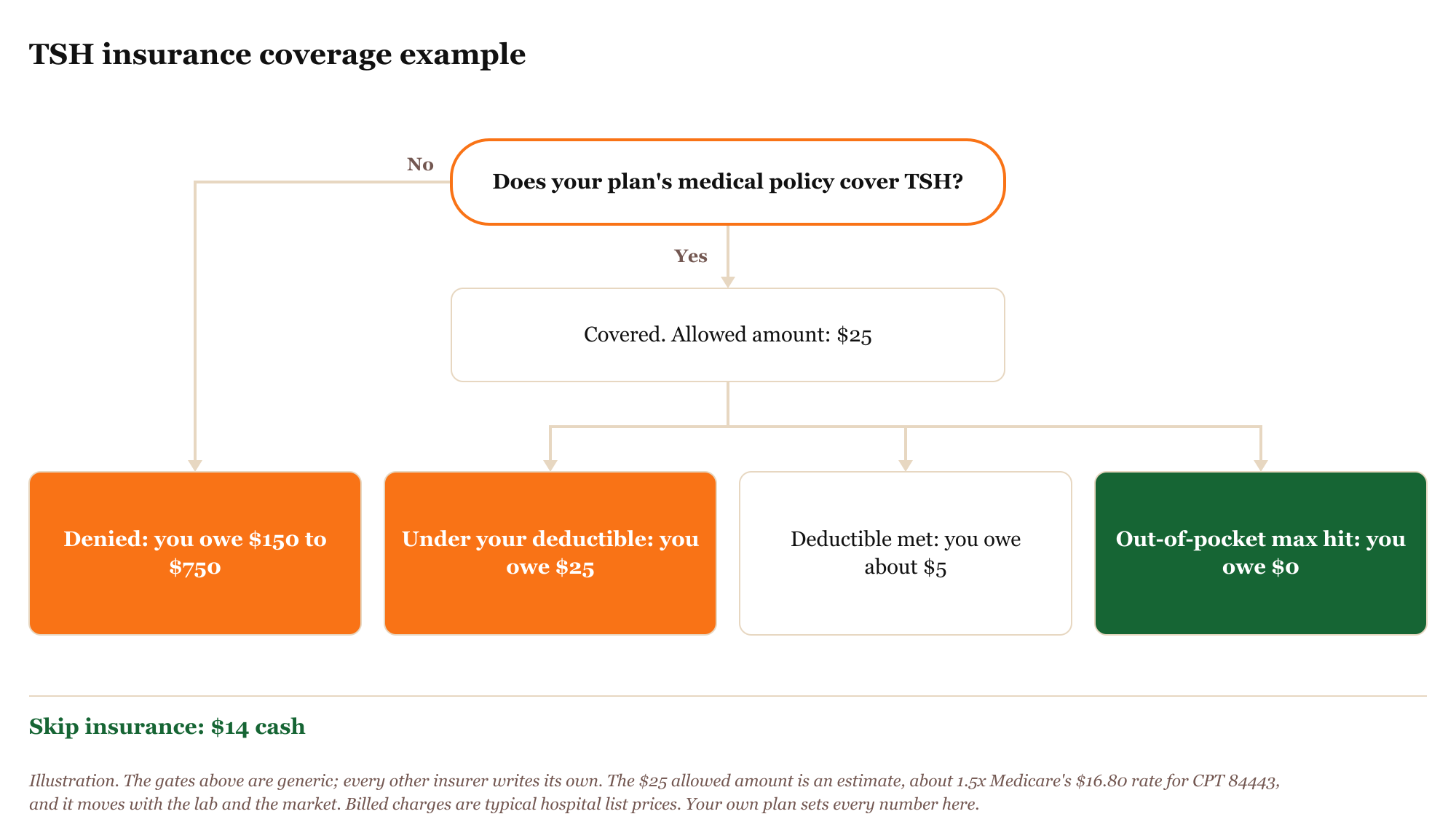
The $25 allowed amount is an estimate, about 1.5x Medicare's $16.80 rate for CPT 84443, and it moves with the lab and the market: the same test is contracted around $18 at one national lab and into the $40s at another. Coinsurance is assumed at 20% once your deductible is met. Your own plan decides both, and most plans apply lab work to the deductible first, so the second outcome above is the one most people land on.
TSH is billed as CPT 84443. That's the code to quote if you call your insurer to ask what you'd owe.
Do medical guidelines recommend a TSH test?
No US body recommends TSH as a routine screening test for healthy adults. What the guidelines support is testing when there's a reason to.
- Preventive screening. The US Preventive Services Task Force gives thyroid screening a Grade I: the evidence is “insufficient to assess the balance of benefits and harms of screening for thyroid dysfunction in nonpregnant, asymptomatic adults.” That isn't a finding that screening is harmful, it's a finding that nobody has shown it helps.
- Symptomatic testing. The picture changes with symptoms. TSH rises before free T4 falls, so it catches an underactive thyroid earlier than the hormone it regulates, which is why it's the standard first test for fatigue, weight change, cold intolerance, or irregular periods rather than a full thyroid panel.
Frequently asked questions about TSH testing
What is the cheapest way to get a TSH test?
The cheapest TSH test is $14–$20 at Mito Health. If you'd rather get more markers out of the same draw, Vitals Vault's 37-biomarker panel is $99.
Do I need a doctor's order to get a TSH test?
No. The standalone TSH tests listed above include the physician order in their price, so you can buy online and have your blood drawn without seeing a doctor first. You'd only need your own doctor's order if you want to bill the test to insurance.
How much does a TSH test cost at LabCorp?
LabCorp doesn't publish a flat consumer price for TSH, and what you're charged varies by location. The cheapest way to have TSH drawn at a LabCorp Patient Service Center is through DrSays, a LabCorp-network lab, at $18.98 all-in ($8.99 + $9.99 collection fee).
What is a normal TSH level?
Most labs use a normal TSH range of roughly 0.4 to 4.0 mIU/L. A high TSH usually points to an underactive thyroid (hypothyroidism), while a low TSH suggests an overactive thyroid (hyperthyroidism).
Do I need to fast for a TSH test?
No fasting is required. Because TSH varies through the day and is typically highest in the early morning, some clinicians prefer a consistent morning draw when monitoring thyroid treatment.