Nutrients
Vitamin D test cost: $23–$81
By Elo. Last updated September 1, 2026.
A vitamin D test costs $23, and for most people the honest answer is to test once rather than annually. It's the most over-ordered test in this category: insurers deny it so routinely that the US Preventive Services Task Force found the evidence “insufficient to assess the balance of benefits and harms of screening for vitamin D deficiency in asymptomatic adults.”
Testing earns its place if you're in a group that's actually likely to be low: little sun exposure, darker skin, older age, higher body weight, or a gut condition that limits absorption. If you're not, a supplement costs less than the test and carries the same evidence behind it.
Below, we compare what a vitamin D test costs at each lab, inside a bundle, and what happens when you put it through insurance.
How much does a Vitamin D test cost?
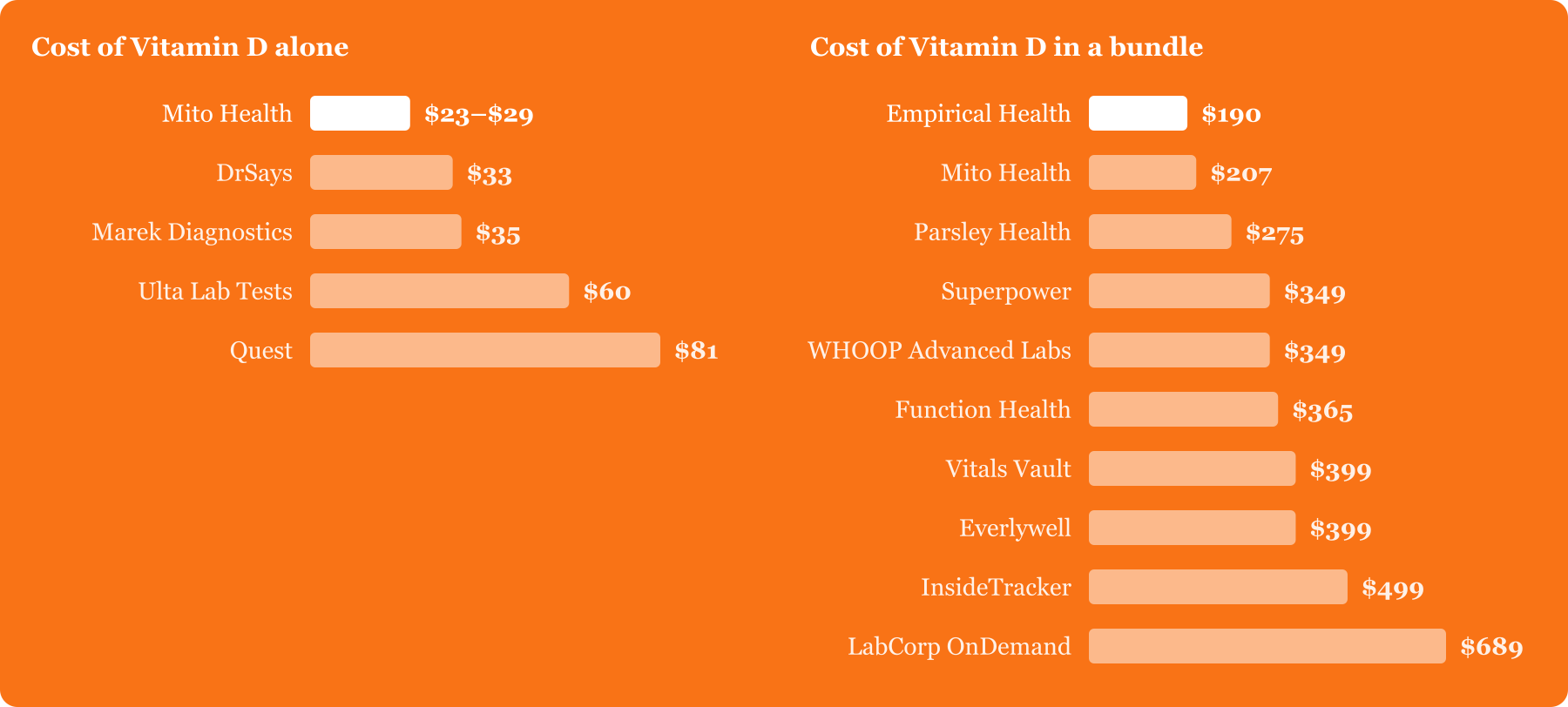
Vitamin D costs $23–$81 on its own, or $190–$689 in a bundle. Those are cash prices, so that's also what Vitamin D costs without insurance.
Lowest Vitamin D self-pay prices
The lowest cash price we found for Vitamin D is $23–$29 at Mito Health, followed by DrSays ($33), Marek Diagnostics ($35), Ulta Lab Tests ($60), and Quest ($81). These are all-in prices that include the draw fee: Mito Health lists Vitamin D at $13.63 and adds a $9.50–$15 draw fee, for $23.13–$28.63 total.
Cost of Vitamin D in a bundle
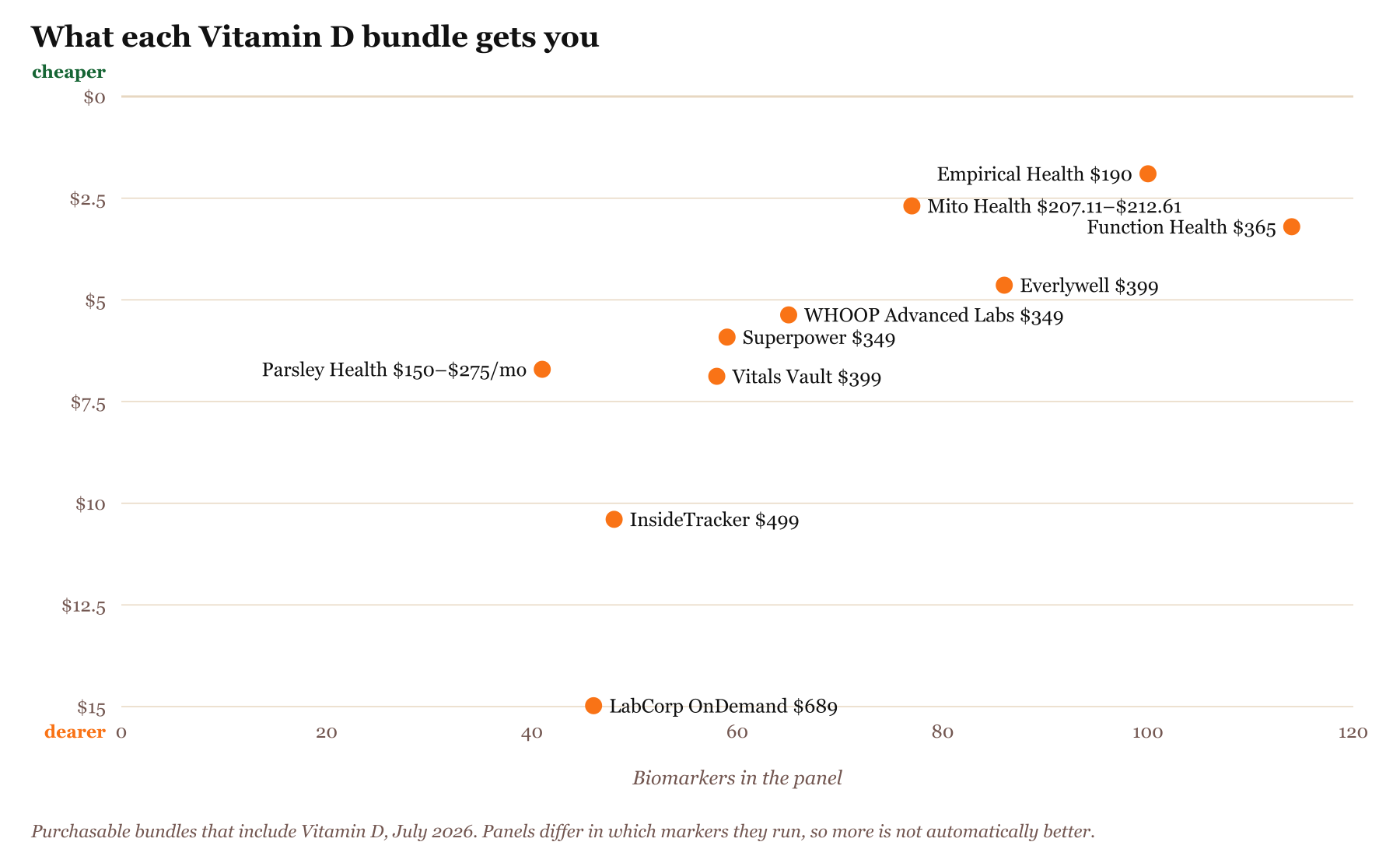
Ten packages we track include Vitamin D, and every one of them tests dozens of other markers from the same draw. The cheapest bundle with Vitamin D is Empirical Health's 100-biomarker panel at $190, then Mito Health ($207 for 77 markers), Parsley Health ($275 for 41 markers), Superpower ($349 for 59 markers), WHOOP Advanced Labs ($349 for 65 markers), Function Health ($365 for 119 markers), Vitals Vault ($399 for 58 markers), Everlywell ($399 for 86 markers), InsideTracker ($499 for 48 markers), and LabCorp OnDemand ($689 for 46 markers).
How much does a Vitamin D test cost at Quest Diagnostics?
At Quest Diagnostics, a Vitamin D test costs $81 on its own.
Is a Vitamin D test worth it?
Worth it once if you're in a group that's likely to be low, not every year. Testing makes sense if you get little sun, cover up, have darker skin, are older, are heavier, or have a gut condition that blocks fat absorption. If you're low, the fix is cheap and you can retest in a few months to confirm it worked. Repeating it annually when you feel fine and your level was normal is the pattern insurers built their denials around, and they have a point.
Either way, the price shouldn't be what decides it: Mito Health sells Vitamin D for $23 all-in. The cheapest panel that includes it is Empirical Health at $190, which is only worth it if you want the other 99 markers too.
What is a normal Vitamin D level?
A normal Vitamin D is 20 ng/mL or higher. The NIH Office of Dietary Supplements calls 20 ng/mL and above adequate for bone and overall health, 12 to under 20 inadequate, and under 12 deficient. It also flags levels above 50 as potentially harmful, so more isn't better here.
Reference intervals differ between labs, so read your own result against the range printed on your report.
Does insurance cover a Vitamin D test?
Insurance usually doesn't cover Vitamin D for screening. Major payers treat it as a screening test and deny it in people without symptoms, and Medicare doesn't cover screening either. When it is covered in-network, you pay about $30 to $60. If the claim is denied, the bill can run $175 to $800, which is why paying the $23 cash price outright is usually safer.
The policy is one sentence: Aetna “considers measurements of serum 25-hydroxyvitamin D experimental, investigational, or unproven for routine preventive screening.” Getting it paid takes a qualifying diagnosis (e.g., osteoporosis, chronic kidney disease, Crohn's, or celiac). Vitamin D is one of the most-ordered and most-denied lab tests in the country, and wanting to know your level isn't a qualifying reason.
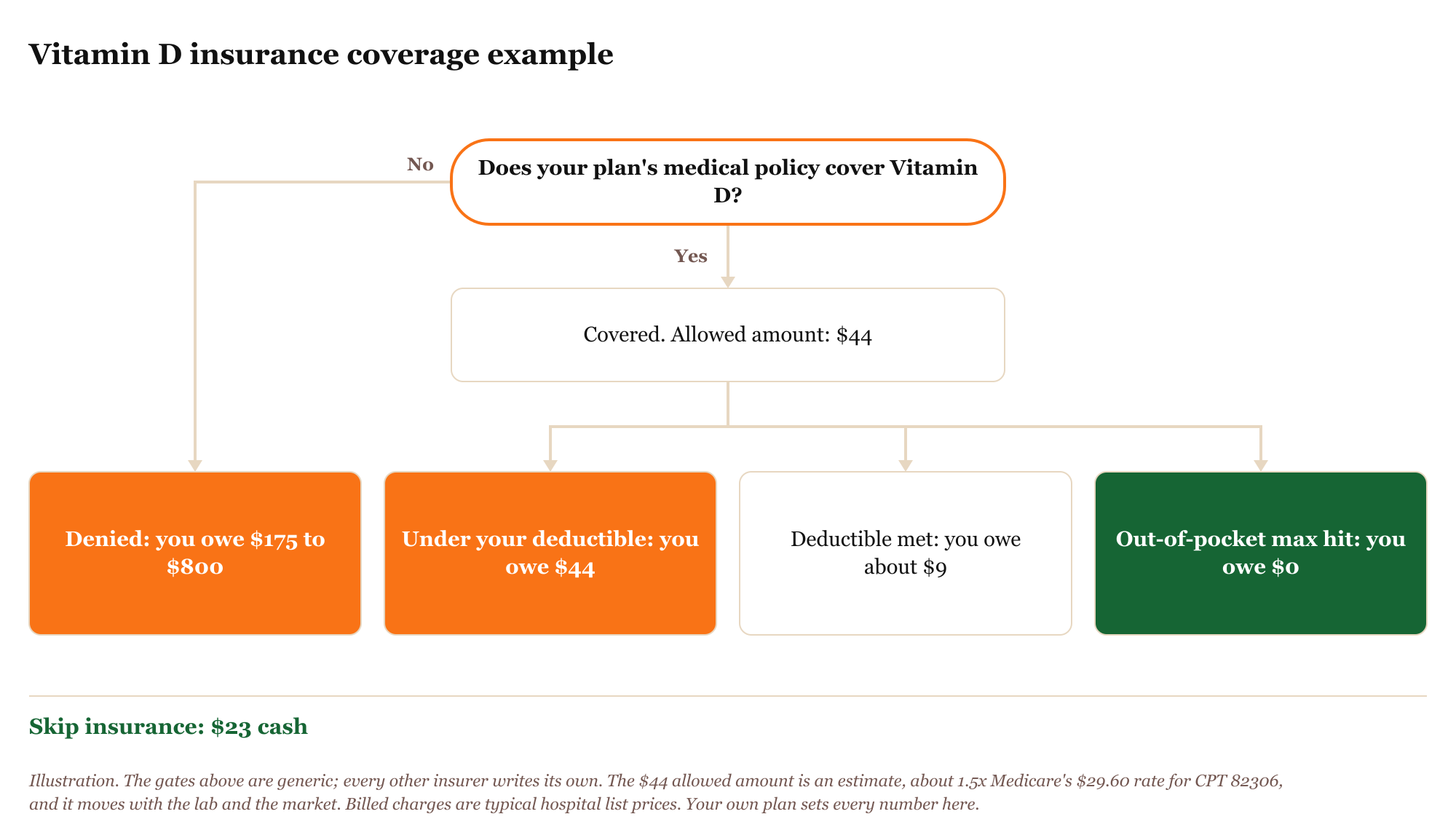
The $44 allowed amount is an estimate, about 1.5x Medicare's $29.60 rate for CPT 82306, and it moves with the lab and the market: the same test is contracted around $18 at one national lab and into the $40s at another. Coinsurance is assumed at 20% once your deductible is met. Your own plan decides both, and most plans apply lab work to the deductible first, so the second outcome above is the one most people land on.
Vitamin D is billed as CPT 82306. That's the code to quote if you call your insurer to ask what you'd owe.
Frequently asked questions about Vitamin D testing
What is the cheapest way to get a Vitamin D test?
The cheapest Vitamin D test is $23–$29 at Mito Health. If you'd rather get more markers out of the same draw, Empirical Health's 100-biomarker panel is $190.
Do I need a doctor's order to get a Vitamin D test?
No. The standalone Vitamin D tests listed above include the physician order in their price, so you can buy online and have your blood drawn without seeing a doctor first. You'd only need your own doctor's order if you want to bill the test to insurance.
How much does a Vitamin D test cost at LabCorp?
LabCorp doesn't publish a flat consumer price for Vitamin D, and what you're charged varies by location. The cheapest way to have Vitamin D drawn at a LabCorp Patient Service Center is through DrSays, a LabCorp-network lab, at $32.98 all-in ($22.99 + $9.99 collection fee).
What is a normal vitamin D level?
Most labs consider a 25-hydroxy vitamin D level of 30 ng/mL or above sufficient. 20 to 29 ng/mL is often called insufficient and below 20 ng/mL deficient, though the optimal target is debated.
Do I need to fast for a vitamin D test?
No. A 25-hydroxy vitamin D test does not require fasting and can be drawn at any time of day.