Heart & Lipids
ApoB test cost: $21–$69
By Elo. Last updated October 18, 2026.
ApoB is a more accurate measure of heart disease risk than LDL cholesterol, and can cost as little as $21. The 2026 ACC/AHA cholesterol guideline recommends it once you're at your cholesterol goal, and lipidologist Dr. Thomas Dayspring calls ApoB “the most tested way to get an accurate atherogenic particle number.”
Hardly anyone orders ApoB by itself. It's usually drawn alongside Lp(a), a lipid panel, and hs-CRP, which together cover inherited risk, cholesterol, and inflammation from the same draw. ApoB and Lp(a) together cost $41 from one lab, on one draw. Our ApoB + Lp(a) + lipid panel price comparison compares every way to order the broader combination.
Below, we compare what ApoB testing costs from cash-pay labs, inside a bundle, and if you run it through insurance.
How much does an ApoB test cost?
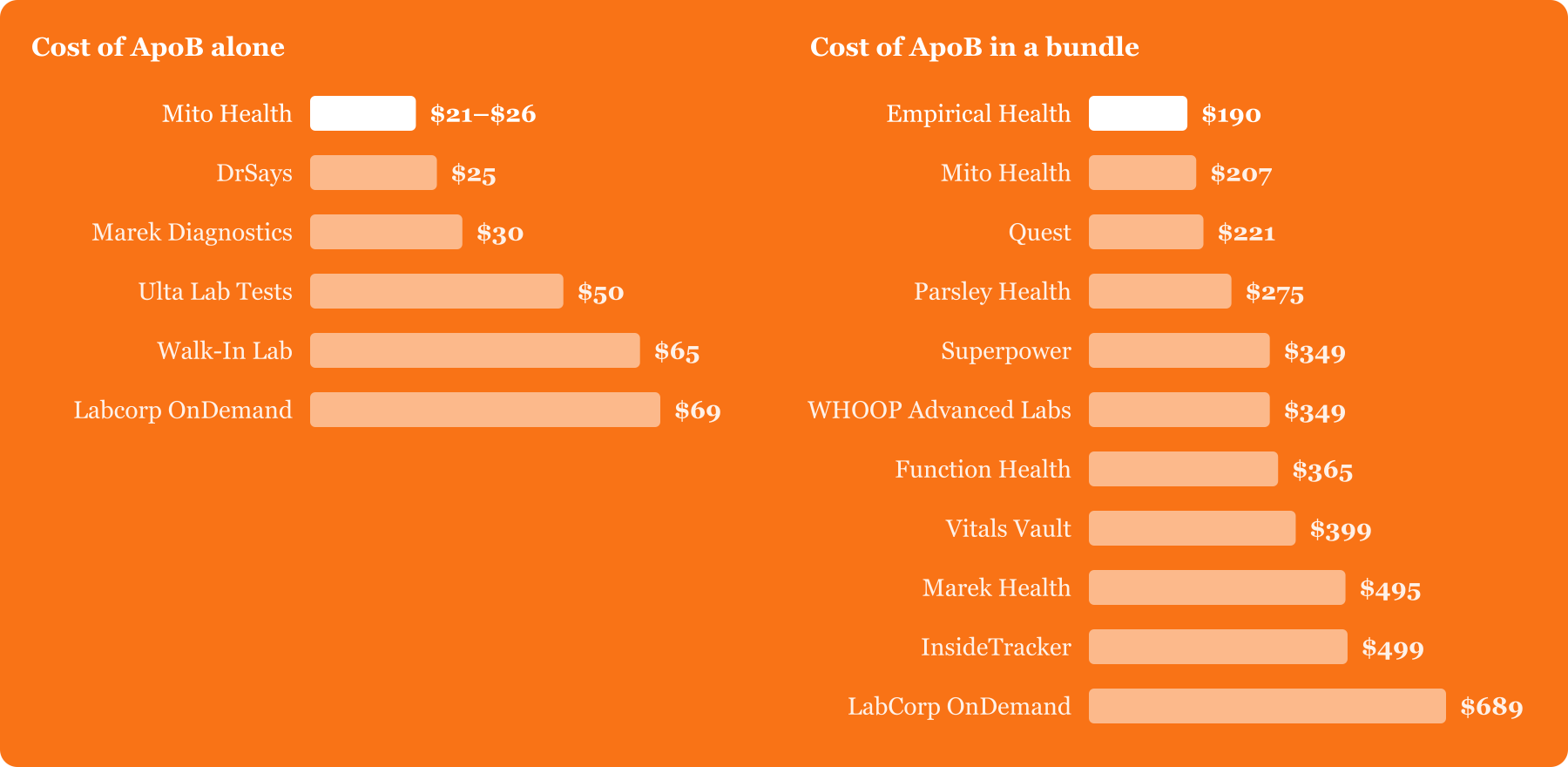
ApoB costs $21–$69 on its own, or $190–$689 in a bundle. Those are cash prices, so that's also what ApoB costs without insurance.
Lowest ApoB self-pay prices
The lowest cash price we found for ApoB is $21–$26 at Mito Health, followed by Own Your Labs ($23), DrSays ($25), Vitals Vault ($27), Marek Diagnostics ($30), JustLabs ($36), Ulta Lab Tests ($50), Walk-In Lab ($65), and Labcorp OnDemand ($69). These are all-in prices that include the draw fee: Mito Health lists ApoB at $11.34 and adds a $9.50–$15 draw fee, for $20.84–$26.34 total.
Own Your Labs: $17.20 + $6 draw fee = $23.20. Verified October 18, 2026. Labcorp draw. Unavailable to residents of MA, MD, NJ, NY, or RI. Regular price; optional 10% data-sharing discount excluded.
JustLabs: $18 + $18 lab & physician order fee = $36. Verified October 18, 2026. Quest draw. One $18 fee per order includes the blood draw and physician order.
Cost of ApoB in a bundle
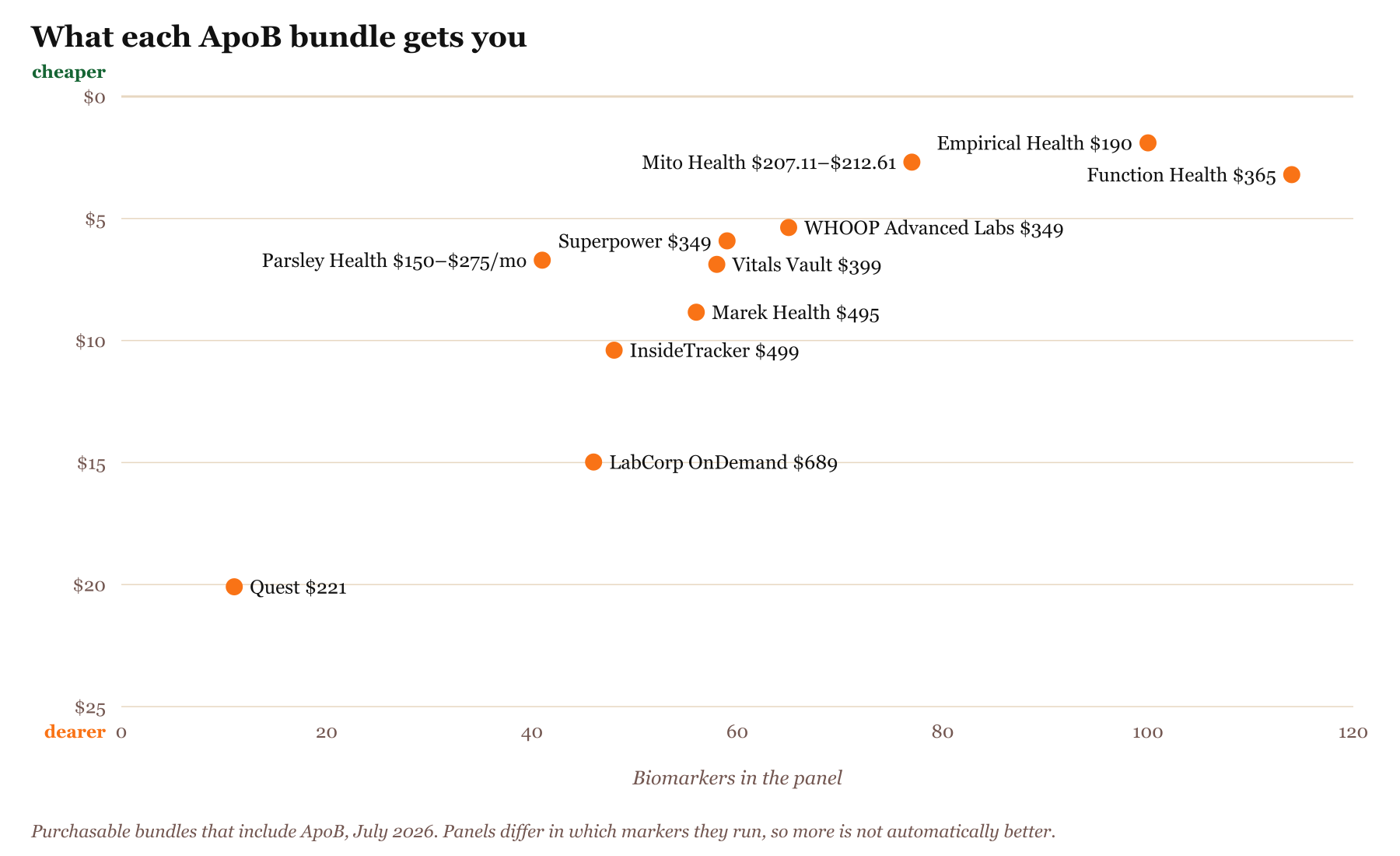
Eleven packages we track include ApoB, and every one of them tests dozens of other markers from the same draw. The cheapest bundle with ApoB is Empirical Health's 100-biomarker panel at $190, then Superpower ($199 for 59 markers), Vitals Vault ($199 for 48 markers), Mito Health ($207 for 77 markers), Quest ($221 for 11 markers), Parsley Health ($275 for 41 markers), WHOOP Advanced Labs ($349 for 65 markers), Function Health ($365 for 119 markers), InsideTracker ($489 for 46 markers), Marek Health ($495 for 56 markers), and LabCorp OnDemand ($689 for 46 markers). Goodlabs includes ApoB in a 14-biomarker panel that's free with a blood donation.
How much does an ApoB test cost at Quest Diagnostics?
Quest Diagnostics doesn't sell ApoB on its own. It only comes in Quest's Advanced Heart Health Panel, at $221. Ordering ApoB alone from another lab we track costs from $21, or $190 if you want a 100-biomarker bundle.
Is an ApoB test worth it?
Yes. If you add one test to a standard lipid panel, I'd make it this one. ApoB counts the particles that actually lodge in artery walls, and it can be high while your LDL looks reassuring, which is the whole reason to measure it. It's most worth it if you have high triglycerides, diabetes or prediabetes, a family history of early heart disease, or an LDL result you weren't sure what to do with. Skip it if you had a normal ApoB recently and nothing about your health or medication has changed since.
Either way, the price shouldn't be what decides it: Mito Health sells ApoB for $21 all-in. The cheapest panel that includes it is Empirical Health at $190, which is only worth it if you want the other 99 markers too.
Does insurance cover an ApoB test?
Insurance usually doesn't cover ApoB for screening. Major payers treat it as a screening test and deny it in people without symptoms, and Medicare doesn't cover screening either. When it is covered in-network, you pay about $20 to $40. If the claim is denied, the bill can run $80 to $600, which is why paying the $21 cash price outright is usually safer.
Aetna covers ApoB only for adults 19 and older who are already on stable lipid-lowering therapy, have hit their LDL-C or non-HDL-C target, and have one high-risk condition (e.g., heart disease or type 2 diabetes). Everything else, including “screening individuals not receiving lipid-lowering therapy,” is listed as experimental, investigational, or unproven. If you're healthy and not on a statin, which describes most people who want an ApoB test, Aetna won't pay for it.
One reader posted an Aetna denial for exactly this pair of tests, ApoB and Lp(a), billed $300 each, right in the middle of the $80 to $600 a denied ApoB claim runs. One person's bill isn't a rule, but it is what the bulletin above looks like in practice.
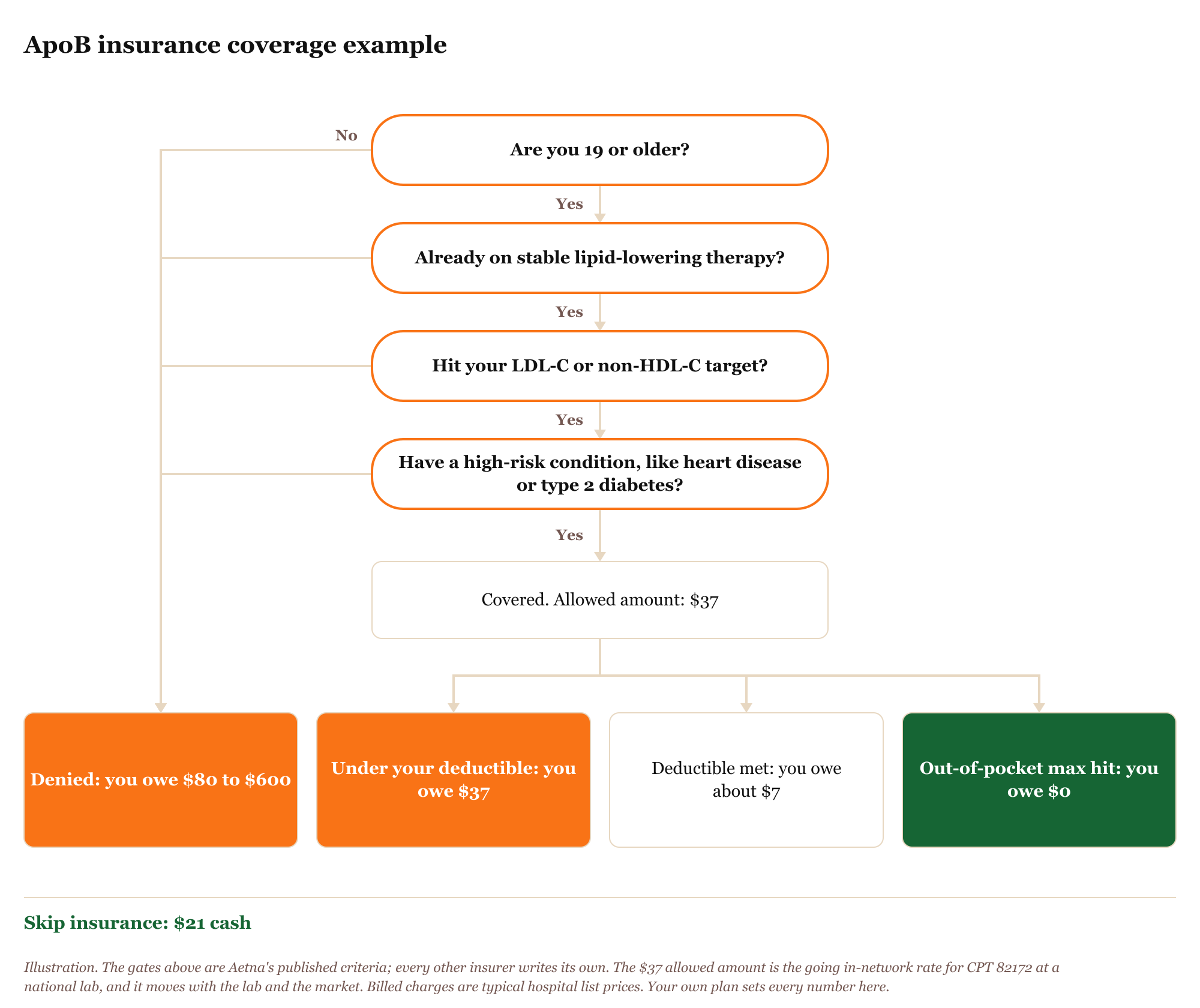
The $37 allowed amount is the going in-network rate for CPT 82172 at a national lab, and it moves with the lab and the market: the same test is contracted around $18 at one national lab and into the $40s at another. Coinsurance is assumed at 20% once your deductible is met. Your own plan decides both, and most plans apply lab work to the deductible first, so the second outcome above is the one most people land on.
ApoB is billed as CPT 82172. That's the code to quote if you call your insurer to ask what you'd owe.
Do medical guidelines recommend an ApoB test?
ApoB isn't yet a routine screening test for every adult, but it has strong and growing support from cardiology authorities and lipid specialists.
- Cardiology guidelines. The American College of Cardiology and American Heart Association's 2026 dyslipidemia guideline added selective ApoB testing to assess remaining cardiovascular risk and guide treatment, for example in people with type 2 diabetes, high triglycerides, or existing heart disease who have already reached their standard cholesterol goals, where ApoB can be a more accurate risk marker than LDL cholesterol.
- European guidelines. Europe got there first. The 2019 ESC/EAS dyslipidaemia guidelines recommend ApoB for risk assessment in people with high triglycerides, diabetes, obesity, metabolic syndrome, or very low LDL cholesterol, and say it can be used instead of LDL-C as the primary measurement for screening, diagnosis, and management where a lab offers it.
- The research literature. Allan Sniderman, the McGill cardiologist who has made the case for ApoB longest, summarized where the evidence stands in Current Opinion in Lipidology: “There is now a robust body of evidence demonstrating the superiority of apoB over LDL-C and non-HDL-C as a clinical marker of cardiovascular risk.”
- Lipid specialists. Lipidologists argue ApoB is a better measure of risk than LDL cholesterol because it counts the actual number of artery-clogging particles in your blood. As Dr. Thomas Dayspring put it on The Peter Attia Drive podcast, “So it's particle number. And the best and easiest way and the most tested way to get an accurate atherogenic particle number is to measure ApoB.”
Frequently asked questions about ApoB testing
What is the cheapest way to get an ApoB test?
The cheapest ApoB test is $21–$26 at Mito Health. If you'd rather get more markers out of the same draw, Empirical Health's 100-biomarker panel is $190.
Do I need a doctor's order to get an ApoB test?
No. The standalone ApoB tests listed above include the physician order in their price, so you can buy online and have your blood drawn without seeing a doctor first. You'd only need your own doctor's order if you want to bill the test to insurance.
How much does an ApoB test cost at LabCorp?
LabCorp doesn't publish a flat consumer price for ApoB, and what you're charged varies by location. The cheapest way to have ApoB drawn at a LabCorp Patient Service Center is through Own Your Labs, a LabCorp-network lab, at $23.20 all-in ($17.20 + $6 draw fee).
How much do ApoB and Lp(a) tests cost together?
Because one blood draw covers both, the cheapest way to get ApoB and Lp(a) together is Mito Health, at $41 for the pair. Empirical Health's 100-biomarker panel ($190) is the cheapest bundle that includes both.
ApoB vs LDL cholesterol, what is the difference?
LDL cholesterol measures the amount of cholesterol carried inside LDL particles, while ApoB counts the particles themselves. Because each atherogenic particle carries exactly one ApoB protein, ApoB reflects the true number of plaque-forming particles, which can be high even when your LDL cholesterol looks normal.
Who should consider an ApoB test?
An ApoB test is most informative if you have high triglycerides, diabetes or prediabetes, metabolic syndrome, a family history of early heart disease, or a borderline LDL result where you want a clearer read on your risk.