Nutrients
Iron test cost: $13–$34
By Elo. Last updated September 1, 2026.
A serum iron test costs $13, and on its own it's close to useless. Your iron level swings through the day and with your last meal, so one value tells you very little.
Ferritin is the test to buy instead. The NIH builds its whole iron-status guidance on ferritin and hemoglobin, and doesn't treat serum iron as a primary measure at all: a ferritin under 30 mcg/L suggests iron deficiency, and under 10 suggests iron deficiency anemia. Serum iron earns its place inside a panel with ferritin, transferrin, and TIBC, where the ratios mean something a single value doesn't.
Below, we compare what an iron test costs at each lab, inside a bundle, and what insurance pays.
How much does an Iron test cost?
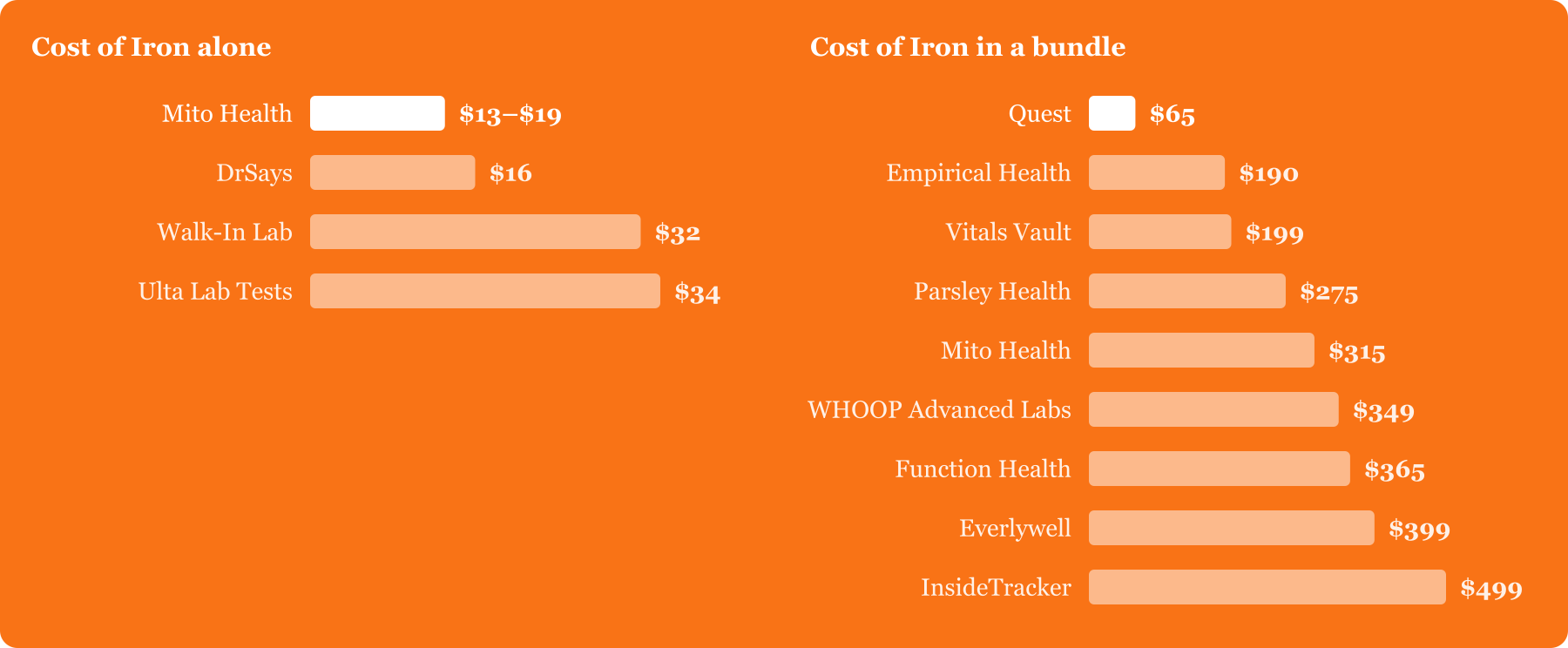
Iron costs $13–$34 on its own, or $65–$499 in a bundle. Those are cash prices, so that's also what Iron costs without insurance.
Lowest Iron self-pay prices
The lowest cash price we found for Iron is $13–$19 at Mito Health, followed by DrSays ($16), Walk-In Lab ($32), and Ulta Lab Tests ($34). These are all-in prices that include the draw fee: Mito Health lists Iron at $3.55 and adds a $9.50–$15 draw fee, for $13.05–$18.55 total.
Cost of Iron in a bundle
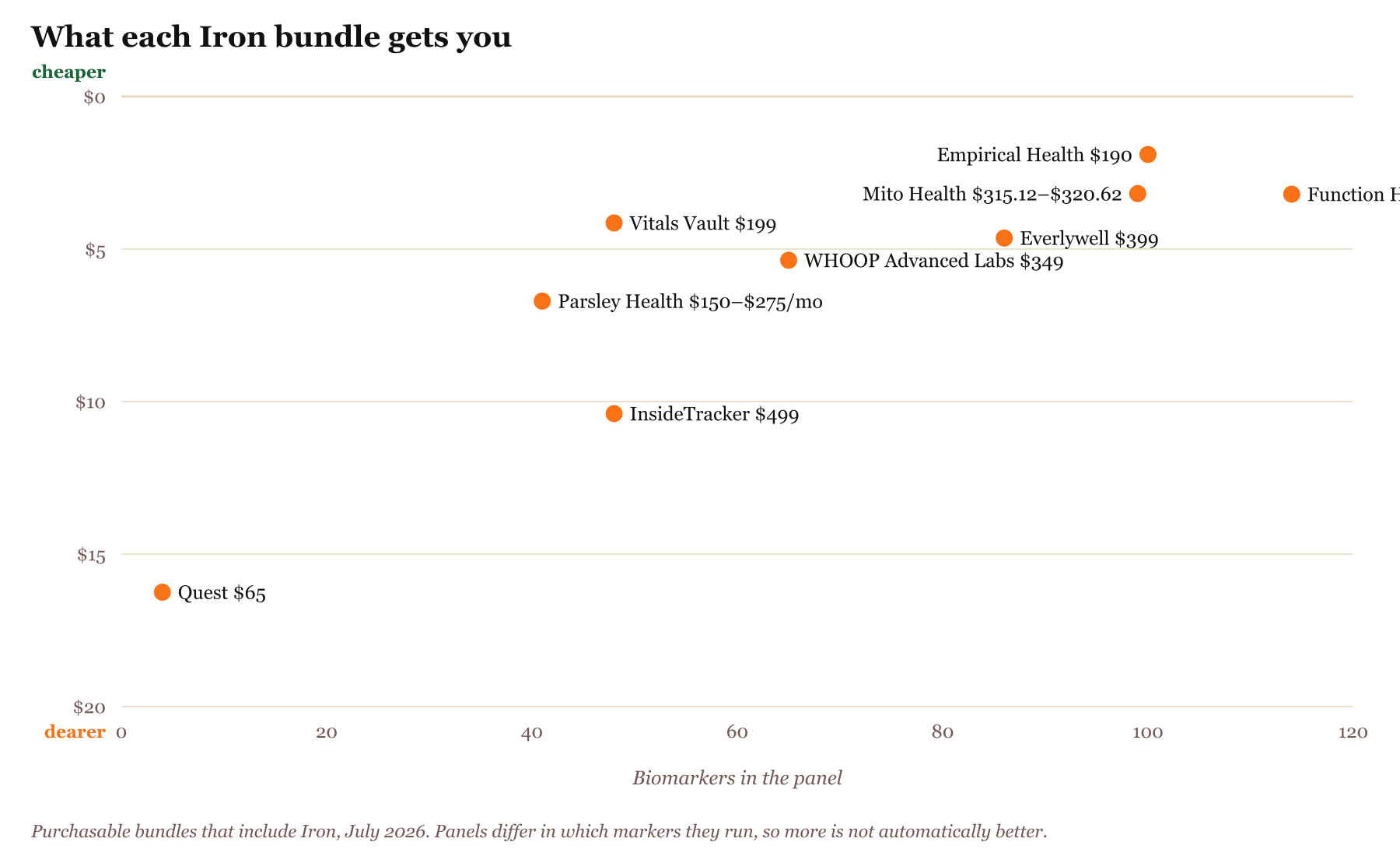
Nine packages we track include Iron, and every one of them tests dozens of other markers from the same draw. The cheapest bundle with Iron is Quest's 4-biomarker panel at $65, then Empirical Health ($190 for 100 markers), Vitals Vault ($199 for 48 markers), Parsley Health ($275 for 41 markers), Mito Health ($315 for 99 markers), WHOOP Advanced Labs ($349 for 65 markers), Function Health ($365 for 119 markers), Everlywell ($399 for 86 markers), and InsideTracker ($499 for 48 markers).
How much does an Iron test cost at Quest Diagnostics?
Quest Diagnostics doesn't sell Iron on its own. It only comes in Quest's Iron, TIBC & Ferritin Panel, at $65. Ordering Iron alone from another lab we track costs from $13, or $65 if you want a 4-biomarker bundle.
Is an Iron test worth it?
Not on its own. Serum iron swings by the hour and with your last meal, so a single value is close to meaningless in isolation. Ferritin is the better first test for iron deficiency. Serum iron earns its keep as part of an iron panel with TIBC and ferritin, which is how a clinician will want to see it.
Either way, the price shouldn't be what decides it: Mito Health sells Iron for $13 all-in. The cheapest panel that includes it is Quest at $65, which is only worth it if you want the other 3 markers too.
Does insurance cover an Iron test?
Insurance usually covers Iron when a doctor orders it for symptoms or a known condition, though you may still owe a copay or deductible. The in-network negotiated cost is about $5 to $15, against $13 if you pay cash. At a hospital lab the billed charge can reach $75 to $400.
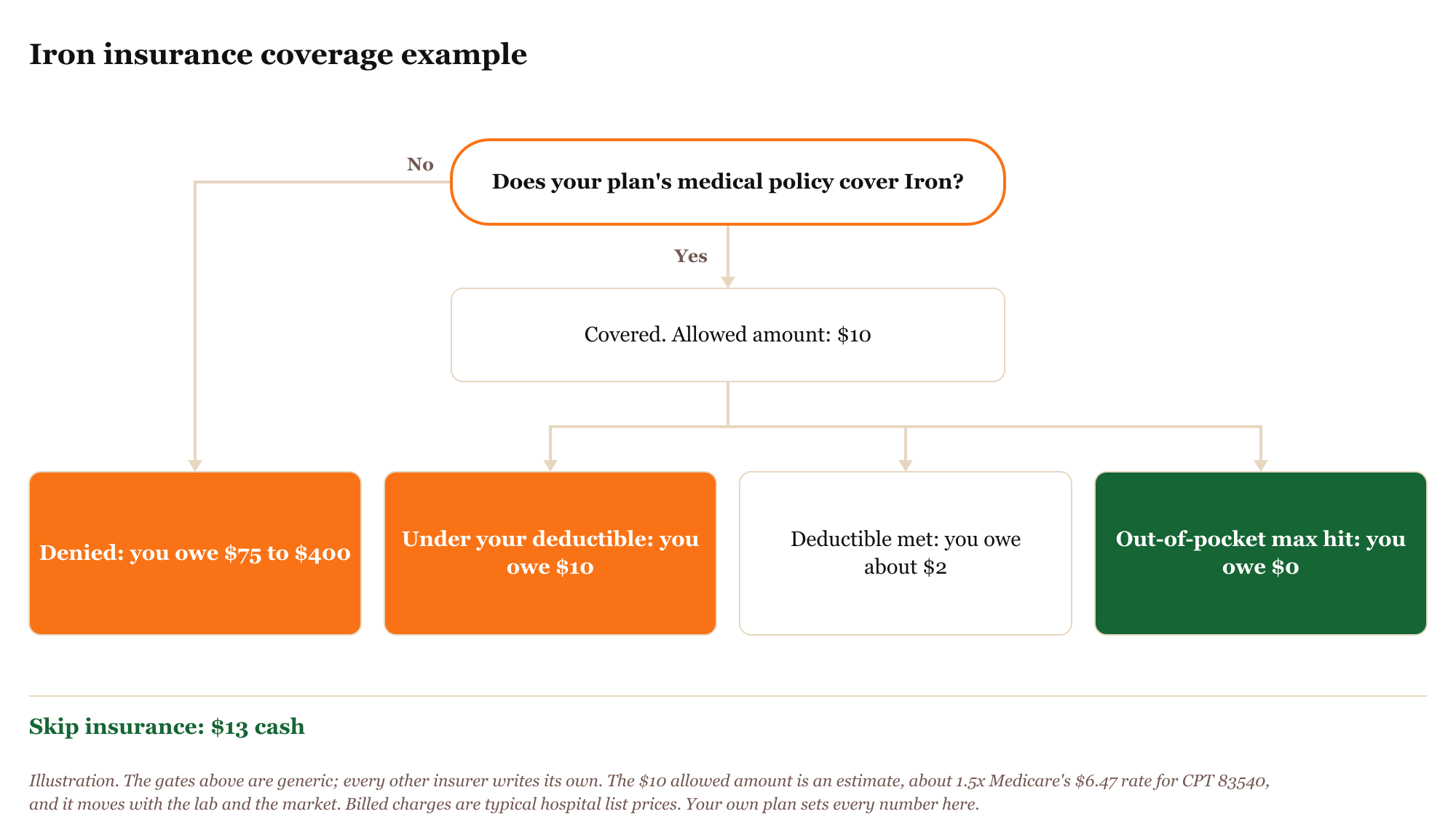
The $10 allowed amount is an estimate, about 1.5x Medicare's $6.47 rate for CPT 83540, and it moves with the lab and the market: the same test is contracted around $18 at one national lab and into the $40s at another. Coinsurance is assumed at 20% once your deductible is met. Your own plan decides both, and most plans apply lab work to the deductible first, so the second outcome above is the one most people land on.
Iron is billed as CPT 83540. That's the code to quote if you call your insurer to ask what you'd owe.
Do medical guidelines recommend an Iron test?
The guidance on iron status is notable for what it leaves out: serum iron, the test on this page, isn't the measure any of it is built on.
- Nutrition guidance. The NIH builds its iron-status guidance on hemoglobin, hematocrit, and ferritin, and doesn't treat serum iron as a primary diagnostic measure. Its thresholds are ferritin-based: under 30 mcg/L suggests iron deficiency, under 10 suggests iron deficiency anemia.
- What serum iron is for. Serum iron earns its place inside an iron panel, read against transferrin, TIBC, and saturation, where the ratios separate deficiency from inflammation. Ordered alone, it mostly reflects what you ate and what time it is.
Frequently asked questions about Iron testing
What is the cheapest way to get an Iron test?
The cheapest Iron test is $13–$19 at Mito Health. If you'd rather get more markers out of the same draw, Quest's 4-biomarker panel is $65.
Do I need a doctor's order to get an Iron test?
No. The standalone Iron tests listed above include the physician order in their price, so you can buy online and have your blood drawn without seeing a doctor first. You'd only need your own doctor's order if you want to bill the test to insurance.
How much does an Iron test cost at LabCorp?
LabCorp doesn't publish a flat consumer price for Iron, and what you're charged varies by location. The cheapest way to have Iron drawn at a LabCorp Patient Service Center is through DrSays, a LabCorp-network lab, at $15.98 all-in ($5.99 + $9.99 collection fee).
What is a normal serum iron level?
Serum iron typically runs about 60 to 170 mcg/dL, but it is interpreted alongside TIBC, transferrin saturation, and ferritin rather than on its own.
Do I need to fast for an iron test?
Often yes. Serum iron varies through the day and rises after meals and iron supplements, so a morning fasting draw is usually preferred for an accurate result.