Neko Health review: what's included in the $499 U.S. scan?
Sources checked · U.S. services
Neko Health's U.S. scan costs $499 and combines skin imaging, cardiovascular measurements, body composition, blood testing, and a clinician consultation in about an hour. New York's first clinic opened September 24, 2026. Neko's U.S. launch.
We reviewed Neko's U.S. test list, equipment descriptions, clinical terms, and follow-up policies. This is a review of the published service, not a first-hand account of a scan. We use the U.S. offering here because older reviews of the UK or Swedish service may describe a different panel.
We'll explain what the visit includes, which blood markers are listed, what further care costs, and how the assessment differs from an MRI.
What does the $499 Neko Health scan include?
| Part of the visit | What you receive |
|---|---|
| Skin | Imaging and mole mapping, with concerning spots reviewed by a dermatologist |
| Body | Body composition information, including visceral-fat assessment |
| Heart and circulation | Electrical and vascular measurements, plus circulation assessment at the feet |
| Blood | On-site testing across nine health areas, with same-visit results |
| Other checks | Grip strength and eye-pressure measurements |
| Consultation | Discussion of results and next steps with a clinician |
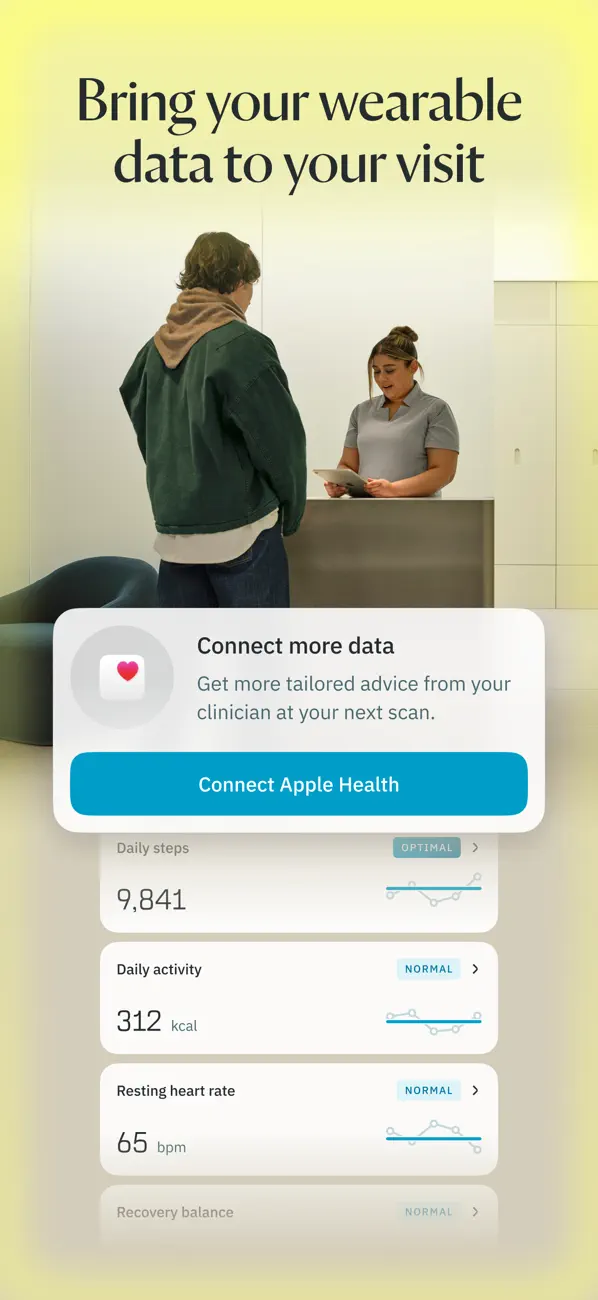
Neko's scan page also describes an app for viewing results and tracking changes, with wearable data connections through Apple Health or Android Health Connect. U.S. scan inclusions.
The launch description allocates roughly 30 minutes to testing and 30 minutes to the consultation. For a person who otherwise needs separate appointments to collect and discuss results, that convenience could be a reason to choose the service. Visit timing.
What does the Neko app look like?
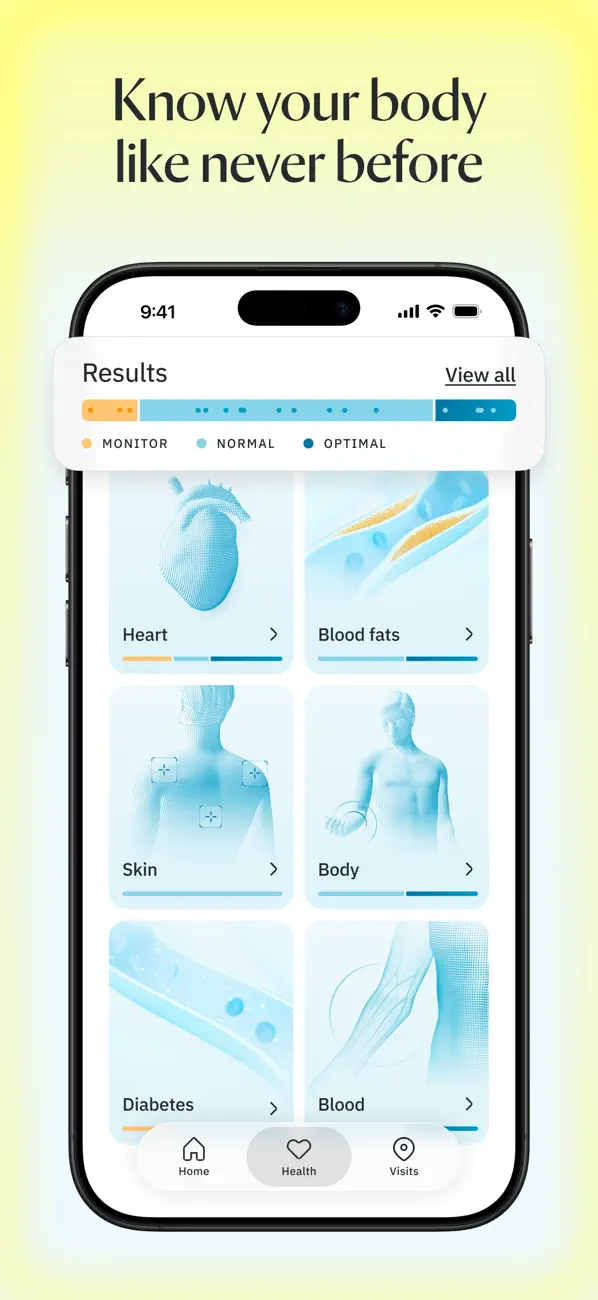
Neko's published app screenshots show results grouped by health area, with categories such as heart, skin, and blood. A separate screen connects Apple Health data for review alongside your scan results.
Which blood tests does Neko Health include?
Neko's U.S. FAQ describes a 53-biomarker panel. Grouped for readability, the published list includes:
| Area | Listed markers |
|---|---|
| Lipids | ApoA1, ApoB, Lp(a), HDL, direct LDL, total/non-HDL cholesterol, triglycerides |
| Glucose | Fasting glucose, HbA1c |
| Inflammation | hs-CRP |
| Kidney/metabolic | Cystatin C, BUN, creatinine, two eGFR calculations, uric acid |
| Liver/protein | Albumin, ALT, AST, GGT, ALP, total/direct bilirubin, conjugated fraction |
| Iron | Iron, ferritin, transferrin, UIBC, TIBC, transferrin saturation |
| Minerals | Calcium, phosphorus, magnesium |
| Blood cells | Red-cell indices, white-cell differential, platelet indices, Ret-He, blasts flag |
TSH, testosterone, estradiol, vitamin D, and B12 aren't listed. Treat these as unconfirmed inclusions, not promised tests. U.S. biomarker list.
Our reading of that list: Neko includes both ordinary cholesterol measurements and additional cardiovascular markers, but the panel isn't a substitute for every thyroid, hormone, or nutrient test. Also, several entries are calculated values or blood-count components. “53 biomarkers” doesn't mean 53 independent disease screens.
If a particular result is why you're booking, confirm the current U.S. panel first. Our blood-test comparison can help you compare that requirement with a lab-focused service.
What does Neko measure beyond blood tests?
Blood pressure, electrical activity, and circulation
Neko's U.S. Scan Facts lists blood pressure at both arms and both ankles, ankle-brachial index, ECG, oxygen saturation, breathing rate, and an estimated aortic pulse-wave velocity. These are different measurements; a single “heart health” label hides how much of the visit is devoted to circulation. U.S. measurements.
Its technology page describes two further approaches. The Echo device uses a laser to measure tiny movements associated with heartbeats. Spectrum uses light at the feet to assess blood and oxygenation in superficial tissue. Neko's product called Echo shouldn't be confused with an ultrasound echocardiogram. Technology descriptions.
Neko doesn't directly image coronary plaque or rule out coronary artery disease. It also doesn't screen for most internal cancers. Clinical limitations.
Skin imaging and body composition
Neko's Derma system combines visible-light cameras, thermal cameras, and depth imaging. It records skin features for review and uses three-dimensional body-shape information to estimate body volume and composition. Those are different methods from MRI imaging of tissue inside the body. How the imaging works.
The service establishes a photographic baseline that can help a clinician compare skin changes over time. An estimate derived from body shape shouldn't automatically be treated as interchangeable with an MRI or DEXA measurement. If you already track body composition elsewhere, ask whether the outputs are comparable before interpreting a change between devices.
Is Neko Health an MRI or a full-body cancer scan?
Neko isn't an MRI or CT scan. Its clinical terms describe a preventive assessment of skin, heart, vessels, and metabolism, with bloodwork and other measurements. It doesn't provide the same kind of internal-organ images as an MRI service. Neko medical services.
That means the first buying question should be what you want assessed. A service that measures cardiovascular risk factors and maps visible skin answers different questions from one that looks for structural abnormalities in internal organs. Neither label, “health scan” or “whole body,” tells you that every disease has been excluded.
Are Neko follow-up appointments included?
Clinically indicated in-house follow-up, including echocardiograms or skin checks, can be included. Outside providers charge separately. Neko clinicians currently don't prescribe. Follow-up FAQ.
Neko's homepage advertises free in-house cardiology and dermatology reviews, analysis, and referrals. Its scan page describes preparing a referral with findings and results when further care is needed. Included follow-up, referral support.
The medical terms explicitly exclude treatment for identified conditions and say Neko isn't a primary care practice. The practical distinction is between explaining or investigating a finding and providing ongoing treatment. Don't budget $499 as covering every service a finding might lead to. Scope of care.
Does Neko accept insurance or HSA/FSA payments?
Neko operates on a self-pay basis. Its U.S. financial agreement says it won't submit insurance claims and accepts HSA/FSA cards. It can provide a receipt, but doesn't promise reimbursement. Confirm eligibility with your plan administrator. Financial agreement.
The advertised amount is a scan price. The public offer doesn't establish an unlimited-care subscription or include a second annual scan. Before prepaying for another visit, ask what repeat testing would change in your care.
Where can you get a Neko Health scan in the U.S.?
The first U.S. clinic is at 300 Lafayette Street in New York's SoHo neighborhood. Neko announced additional New York locations and Miami, with Washington, DC and San Francisco planned. Those announcements don't establish that the additional clinics are open. September 24 launch announcement.
As of September 28, the U.S. homepage says New York is open while still directing visitors to a waitlist. An open clinic doesn't guarantee an immediately available appointment. Current booking entry point.
What evidence supports Neko Health?
Neko's September 2026 report describes improvements in several risk markers among returning UK and Swedish members. It also acknowledges that the data are observational, participants chose whether to return, and there was no randomized control group. The findings don't establish that the scan caused the improvements. Neko's Year Three report.
The same report notes incomplete referral outcomes and says its serious-disease detection data come from Sweden. Those results shouldn't be presented as a measured detection rate for the new U.S. service. Separately, Neko lists ongoing Swedish studies investigating microcirculation, cardiovascular measurements, and type 1 diabetes. Report limitations, clinical research.
I'd evaluate Neko as a convenient way to collect and discuss a defined set of measurements. The strongest reason to pay is that those measurements could inform decisions you'll act on. If your main goal is a particular lab test, internal-organ imaging, or ongoing treatment, compare that need directly with the included services before booking.