The cost of common lab tests can vary by 60x
One of the most frustrating things about the US healthcare system is its sheer opacity. Even the price of simple commodities can vary 60x with no real underlying difference in what you are getting.
Lab tests are an especially egregious case. A cholesterol panel is a cholesterol panel; the lab runs the same instrument on the same tube of blood regardless of who ordered it. Yet the price of the exact same test can vary by more than 5,000%, from $14 to $800, depending on where you get it and whether insurance pays.
I analyzed the price of 16 common lab tests. _None_ of them had variance of less than 2,000%. The most variable test had a 76x spread in price.
What 16 common lab tests cost
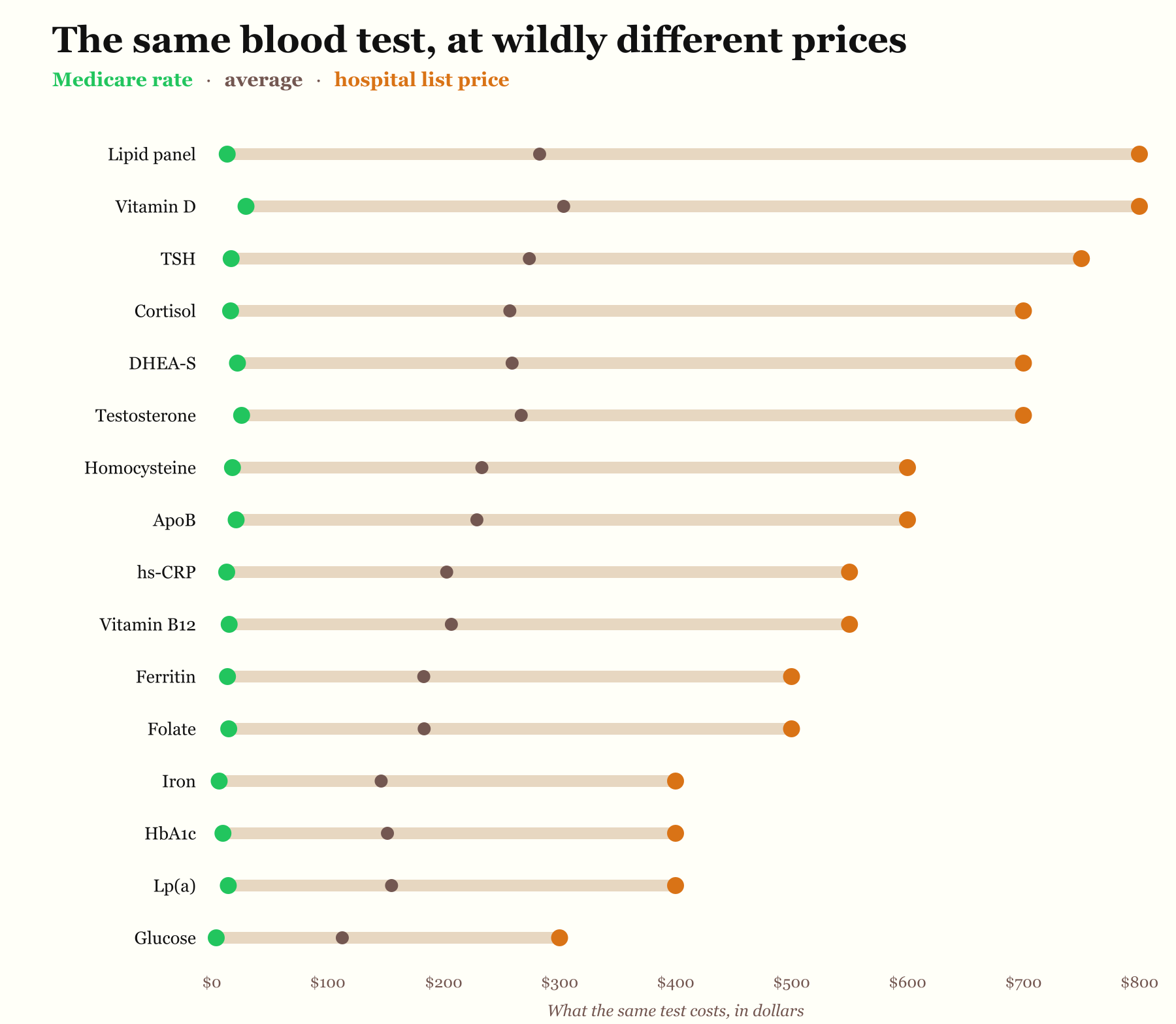
| Blood test | Min Medicare | Cash DTC lab | Max Hospital | Average | Variation |
|---|---|---|---|---|---|
| Lipid panel (LDL, HDL, cholesterol, triglycerides) | $13.39 | $19 | $800 | $277 | 60x |
| Vitamin D | $29.60 | $23 | $800 | $284 | 27x |
| TSH (thyroid) | $16.80 | $14 | $750 | $260 | 45x |
| Cortisol | $16.30 | $17 | $700 | $244 | 43x |
| DHEA-Sulfate | $22.23 | $20 | $700 | $247 | 31x |
| Testosterone | $25.81 | $16 | $700 | $247 | 27x |
| Homocysteine | $17.92 | $22 | $600 | $213 | 33x |
| ApoB (Apolipoprotein B) | $21.09 | $21 | $600 | $214 | 28x |
| hs-CRP (inflammation) | $12.95 | $18 | $550 | $194 | 42x |
| Vitamin B12 | $15.08 | $19 | $550 | $195 | 36x |
| Ferritin | $13.63 | $18 | $500 | $177 | 37x |
| Folate | $14.70 | $15 | $500 | $177 | 34x |
| Iron (serum) | $6.47 | $13 | $400 | $140 | 62x |
| Hemoglobin A1c | $9.71 | $15 | $400 | $142 | 41x |
| Lp(a) | $14.32 | $24 | $400 | $146 | 28x |
| Glucose (fasting) | $3.93 | $12 | $300 | $105 | 76x |
Min = the Medicare national rate. Cash = the cheapest all-in direct-to-consumer price we track (each lab's list price plus its draw or physician fee). Max = hospital chargemaster rate. Variation = max ÷ min. The four lipid markers are shown as one row because they are ordered, priced, and billed together as CPT 80061.
Cheap tests have the wide spreads
Oddly, the tests that cost the least to run vary the most. It seems like nothing anchors the top of the range to the real cost. A glucose test, among the most ordered in medicine, is valued by Medicare at $3.93. You can buy it yourself for about $12. A hospital can bill up to $300, a 7,534% spread.
The gap is also surprisingly wide for tests an insurer can decline. Vitamin D is one of the most requested tests in the country, yet because it's not a US Preventive Services Task Force recommended test, most health insurers deny it. This means that a denied claim can leave a hospital bill up to $800. The same holds for the advanced heart markers ApoB and Lp(a), which recent cardiology guidelines increasingly recommend: Medicare values them at $21.09 and $14.32, but as non-routine screening they are frequently denied for healthy people, leaving charges that can reach $600 and $400.
Why healthcare pricing is so opaque and complex
Under the hood, there are four completely different pricing systems for the same underlying lab test:
1. The Medicare rate. It is what the largest payer in the country has decided a test is worth, and long the lowest price on the board. That is starting to change: marketplaces that resell lab tests near wholesale now undercut Medicare on several of the markers above, including vitamin D, TSH, and testosterone.
2. The chargemaster rate. Every hospital keeps a master list of prices called the chargemaster, and the numbers on it are basically made up. This is where the $800 lipid panel can be billed.
3. The negotiated insurance rate. If you have insurance and the test is covered, your plan pays some rate it privately negotiated with the lab. You almost never get to see this number before the fact. It varies by insurer, by contract, by facility, and it is the reason two people in the same waiting room can be charged different amounts for the identical draw.
4. The cash pay rate. Direct-to-consumer providers negotiate with labs, and quote a cash pay rate for these tests. (Most of the time, you can use an HSA or FSA for this rate).
Why price transparency hasn't fixed it
We were supposed to have solved this by now. Two major federal laws have fallen short:
The Hospital Price Transparency rule (2021) requires every hospital to post a machine-readable file of its standard charges, including the rates it negotiates with each insurer, plus a consumer-friendly display of 300 common shoppable services. On paper this should end the guessing. In practice, the first penalty for ignoring it was only a few hundred dollars a day, capped near $109,000 a year, which is a rounding error for a large hospital, so many simply did not comply.Independent audits found only 21%-36% of hospitals were compliant across its 2023 and 2024 reports. CMS later raised the maximum penalty to roughly $2 million a year for the largest hospitals and compliance improved, but the files that do get posted are built for machines, not patients: sprawling spreadsheets with thousands of coded line items.
No Surprises Act (2022) bans balance billing for emergencies and for out-of-network care delivered at in-network facilities. It entitles uninsured and cash-pay patients to a good-faith estimate up front. But it was written for surprise bills, not for routine shopping. A cholesterol test that a healthy person orders and an insurer later denies is not a "surprise" bill under the law, so the $800 charge that mostly sits outside its protections after a denial.
Opacity is a feature, not a bug
The deeper reason the rules underdeliver is that opacity is not really a bug in this system, it is a feature. At least, it's a feature for the hospital systems and insuers who profit from it.
Negotiated rates are treated as trade secrets, and neither hospitals nor insurers gain much from making them transparent, so both do the literal minimum the regulations demand. The chargemaster rate stays inflated because it anchors negotiations and sets a high "sticker price" for anyone out of network. Government enforcement is thin relative to the size of the industry.
So can you do?
This is a bummer of a topic, but I do think there are a few things you can do to get a better deal:
1. Shop around. Shop around for the best price. The cash price is often cheaper than your insurance copay. Use this or other sites to compare prices.
2. Use an HSA or FSA. If you have an HSA or FSA, you can use it to pay for a test.
3. Ask for a good faith estimate. If you are uninsured or have high-deductible insurance, you can ask your doctor for a good-faith estimate of the cost of a test. This is not a guarantee, but it is a starting point.